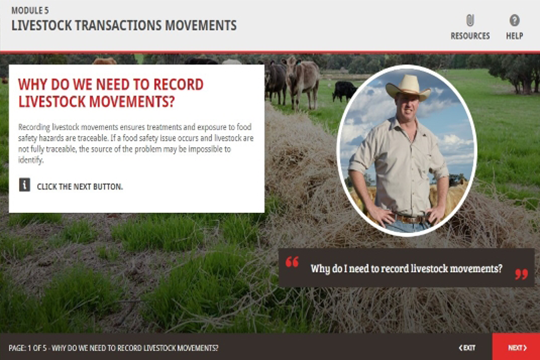
LPA Learning
Consolidate your knowledge on by livestock transaction and movements by completing this LPA Learning module.
To guarantee animals sold are not exposed to food safety hazards and meet all traceability requirements, should a safety issue occur, livestock producers are required to:
Recording livestock movements ensures treatments and exposure to food safety hazards are traceable. If a food safety issue occurs and livestock are not fully traceable, the source of the problem may be impossible to identify. All livestock need to be fully traceable to allow a fast and efficient response. This will minimise any potential harm to people or animals, and protect the reputation of Australian red meat. Our customers expect our product to be fully traceable.
The NLIS is Australia's system for identification and traceability of livestock, allowing cattle, sheep and goats to be traced from property of birth to slaughter for:
All livestock movements onto or off a PIC must be identified by an NLIS-accredited electronic or visual device before they are moved or sold, and recorded on the NLIS database in accordance with the NLIS requirements for your state or territory.
NLIS accredited devices for cattle must be an electronic (RFID) device. This can be either a single ear tag, or a rumen bolus/visual ear tag combination. All cattle must be tagged with an NLIS accredited device before being moved off a property.
NLIS tags and devices should be ordered for your PIC through your state/territory’s nominated authority.
Find out more information about NLIS-accredited cattle devices.
Devices accredited by NLIS have the NLIS logo printed on them. Cattle devices also have the words ‘Do not remove’ printed on the ‘male’ button.
NLIS-accredited devices for sheep and goats can be either an electronic (RFID) device or a visual (non-electronic) tag. Sheep and goats can only be identified by ear tags/devices.
All sheep and goats must be tagged with an NLIS-accredited tag or device before being moved off a property. However, some tagging exemptions are in place for rangeland goats harvested from the wild and dairy goats in some states and territories. For more information check with your state/territory NLIS authority.
Find out more information on NLIS-accredited sheep and goat devices available.
NLIS tags and devices should be ordered for your PIC through your state/territory’s nominated authority.
Consolidate your knowledge on by livestock transaction and movements by completing this LPA Learning module.
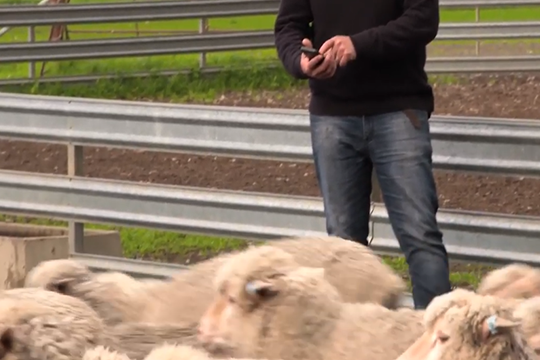
Watch this video to understand how to meet traceability requirements for all livestock movements – between farms and feedlots, and including to slaughter and live export
Current LPA NVDs, electronic NVDs (eNVDs) and eDECs are available through your LPA account.
You can register for an NLIS account on the NLIS website.
Once submitted, your account request will need to be approved. This process can take up to seven days. After your request is approved, you will receive your NLIS user ID and password via email.
How to record livestock movements
The information required to record a livestock movement on the NLIS database will vary according to the origin and destination of the movement, and the type of identification tags attached to the livestock.
Livestock movements with electronic tags – or RFID tags – should be recorded using the Livestock moved onto/off my property function. Access ISC's NLIS how-to guide for moving livestock onto or off a PIC (type in details) or how-to guide to moving livestock onto or off a PIC (file upload) for assistance with this. Livestock movements with visual tags should be recorded using the mob-based movement onto/off my property function. Access ISC's NLIS how-to guide for moving mobs onto or off a PIC (type in details) or how to guide to moving mobs onto or off a PIC (file upload) for assistance with this.
Who is responsible for movements?
If livestock are bought, sold or moved through a saleyard, the livestock movement must be recorded by the saleyard. For private sales – those that do not take place via a saleyard – the buyer/receiver of the livestock must record the livestock movement onto their property.
The vendor/sender of the livestock is not obligated to record the movement off their property, although they are encouraged to do so. They should check the movement has been made by the buyer/receiver.
Industry representative bodies have decided it is the buyer/receiver who makes the transfer and this has been legislated in each state.
Buying through an agent
If you buy stock privately through an agent, it is your responsibility as the receiver of stock to make sure the transfer is completed. While you can do it yourself, or ask your agent to do it for you, ISC recommends you clarify who will do it when the sale is made. You should ask for the Upload ID as a receipt to show it has been done if your agent completes the transfer. This Upload ID can be written on the NVD waybill that the stock arrive with – making it easy to check later and to show an LPA auditor.
Accidental sales or transfers
If livestock are accidentally sold by another producer and this is recorded on the NLIS database to your PIC, then this will generate a ‘system transfer’ warning. This is an automated warning from the database that notifies the PIC holder that an animal registered on their PIC has been moved off to another PIC. You will need to have an NLIS database account to receive the email notifications/warnings.
Read more about warning emails.
If livestock have spread to neighbouring properties, producers should consider any risks around pest, disease and biosecurity for their own property before they are brought home. A number of recommended practices are included on the LPA Farm Biosecurity Plan template that should be considered.
The NLIS database should be used to reconcile livestock numbers and updated with the number of head residing on the property. Producers should scan and upload active animals on the PIC to the NLIS database.
While it is not a mandatory requirement, you can also notify the database of any animals that have died on your property.