Search tips
- Check your spelling
- Try a different term
- Keep your search term short and simple
More information For up-to-date information on compliance with ESI, visit the APVMA website. If you require further assistance with understanding the requirements of ESI or WHP, you can speak with the ISC Customer Service team on 1800 683 111, Monday-Friday between 8am and 7pm (AEST) or on weekends between 9am and 5pm (AEST). You can also access the ISC Chatbot seven days a week via our website or from your myMLA and LPA account pages.

Producers must keep accurate farm records to demonstrate that their on-farm practices meet LPA requirements. LPA accreditation certifies that meat has been produced safely, ethically and meets biosecurity requirements – and producers must have the evidence to demonstrate this. You can encourage your clients to keep good farm records for LPA, as well as records for any services you may provide. The LPA record keeping templates include all details that must be recorded on-farm to meet LPA requirements. Keep in mind that the LPA record keeping templates are not compulsory to use. If there are opportunities to incorporate record keeping...
The National Livestock Identification System (NLIS) is Australia's system for the identification and traceability of cattle, sheep and goats. NLIS reflects Australia's commitment to biosecurity and food safety and provides us with a competitive advantage in a global market. Livestock producers need to ensure that the NLIS database for their property identification code is up-to-date. Records of livestock transfers and movements can also be part of an on-farm audit. This session will help you to stand by what you sell by: Reintroducing the NLIS database, what producers need to use it for and how to access it. Demonstrating how to...
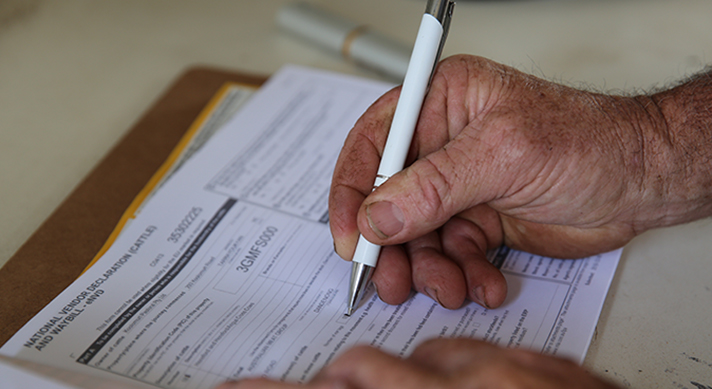
There are two steps for signing an eNVD. Part A First, the producer must sign the eNVD, as it serves as a declaration confirming compliance with LPA requirements and accuracy of the document. LPA NVDs are legal documents and part of record keeping, subject to audit. Part B Second, the livestock transporter completes the Transporter Section, either digitally via their app or on the printed eNVD. If signing digitally they can: Scenario 1: "The transporter has a myMLA account and his/her myMLA email has been entered into the transporter section of the consignment" They can login to...
Join this webinar, held in partnership with NSW Department of Primary Industries, for tips and hints on how to use the NLIS database on-farm.
For more information, refer to:C. bovis Factsheet Property risk assessment Updated LPA Standards
Property risk assessments and farm biosecurity plans can now be created digitally online within a producer’s LPA account.
Join this webinar, held in partnership with the Department of Primary Industries, Parks, Water and Environment and Tasmanian Farmers and Graziers Association, for tips and hints on how to use the NLIS database on-farm.
Join this webinar, held in partnership with the Department of Primary Industries and Regions and Livestock SA, for tips and hints on how to use the NLIS database on-farm.
Join this webinar, held in partnership with Agriculture Victoria, for tips and hints on how to use the NLIS database on-farm.